
 EN
EN TR
TR AR
AR FR
FRThe pivot point
A reinforced concrete base carries the machine and the water connection. Power and control arrive here, and the collector rings feed a machine that never stops turning.
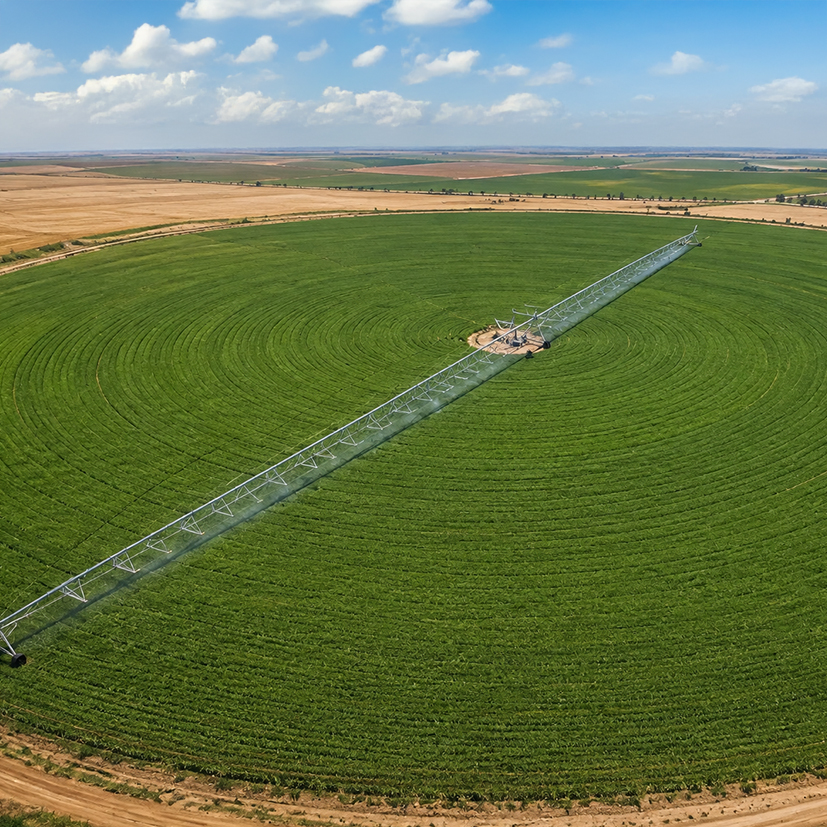
Fully galvanized spans turning about one reinforced base, watering thousands of decares automatically at 90–95% water use efficiency — engineered in our own factory in Konya around your field, your soil and your water source.
One fixed point, one rotation, one even pass. Everything else on the machine exists to keep those three things true.
A reinforced concrete base carries the machine and the water connection. Power and control arrive here, and the collector rings feed a machine that never stops turning.
Fully galvanized steel pipe on a steel truss carries the water outward. Span count and length are matched to the circle you are irrigating.
Each tower carries a gearmotor, a wheel gearbox and a tower box. The alignment switch keeps every tower in station on the one outside it.
Sprinklers graded span by span apply the same depth across the whole circle. Application is homogeneous, which is where the saving in labour, water and time comes from.
Every machine is customised to the terrain and to what the grower actually needs. Control panels, connection systems and irrigation outlets are all arranged for the specific field, so the layout that arrives is the one that suits the ground it stands on.
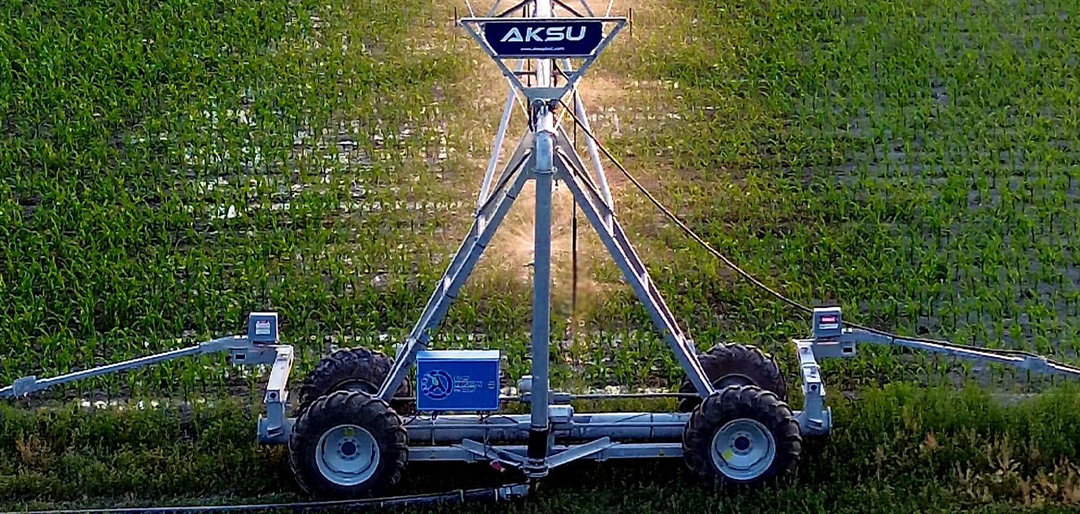
The tower chassis is built straighter and better balanced than a conventional pivot frame. That structural balance stops the chassis sagging, which is what keeps the machine stable through a long irrigation and stops it deforming over years of use. It stands higher off the ground than other pivot chassis, so tractors and large machinery pass underneath and field work carries on while the machine runs.
Structural parts are hot-dip galvanized after fabrication, so cut edges, drilled outlets and weld seams are protected too. The system is designed to hold up across different water conditions, and a corrosion warranty is available with it.
Every part below is manufactured or stocked by AksuPivot, and every one of them has its own page in the spare parts catalogue.
The fixed base, the water connection and the slip rings that feed a turning machine.
See the partCast, oil-filled worm gearbox on the hub, fed by a gearmotor that demounts independently of the transmission.
See the partGalvanized base, UV-stabilised housing, steel camshaft and moisture-proof micro switches.
See the partKomet or Senninger heads with nozzles graded span by span for the soil and the crop.
See the partDigital or standard, both supplied for a new build or as a retrofit to a machine in the field.
See the partDrilled to your outlet spacing, galvanized inside and out.
See the partNo machine suits every parcel. This is where this one does and does not fit — the other two are compared below.
All three are built on the same galvanized spans, the same tower drive and the same control panel. The choice is about the shape of the land, not about the machine you are tied to afterwards.
Thousands of decares from a single reinforced base, depending on span count and the water available. The span count and machine length are set from your parcel area when the layout is drawn.
Yes. The machines work readily on sloping terrain. Slope affects the specification rather than the choice: it sets the tower drive and wheel package, and it is why pressure regulators matter — they hold nozzle pressure constant as the machine climbs.
A center pivot waters the circle inscribed in the parcel, so the corners stay dry. On a large field that is usually an acceptable trade for the lowest cost per decare. Where the corners matter, a linear machine reaches up to 98% of the same ground.
Yes. Both the digital and the standard panel are supplied for new builds and as retrofits, with the contactors sized for the machine.